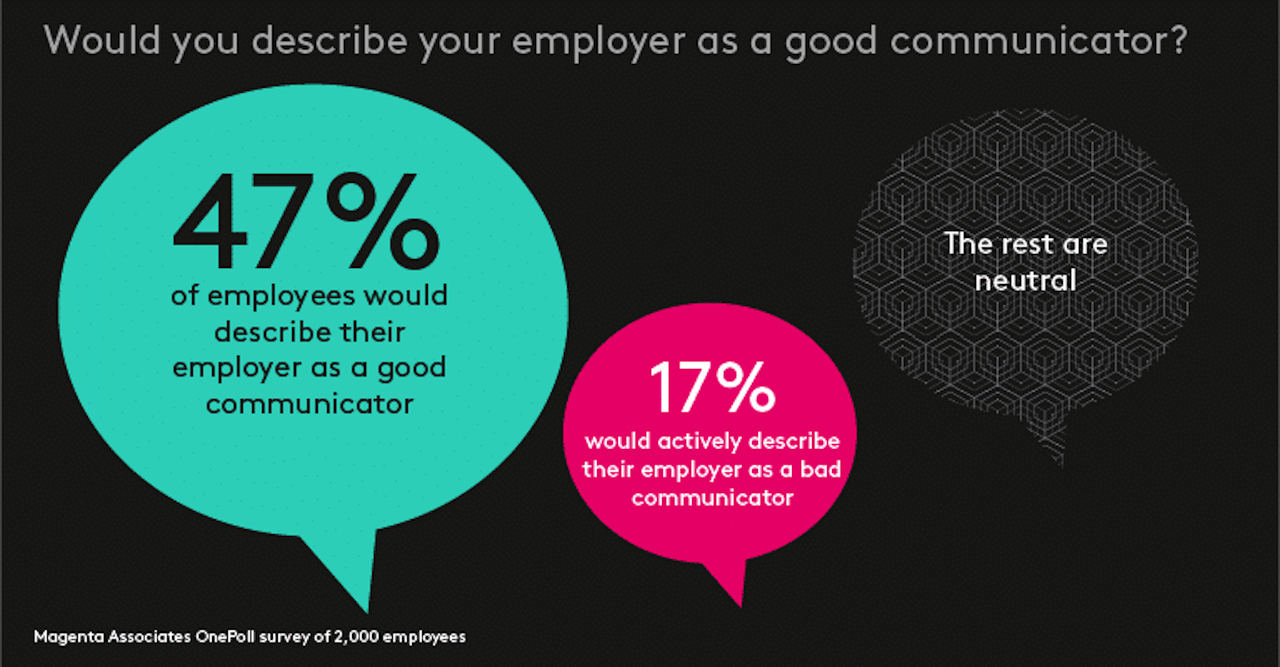
A survey of 2,000 employees has revealed that more than half (53 per cent) do not describe their employer as a good communicator, and 70 per cent cannot agree that their employer is clear about the company’s work policy now that Covid-19 restrictions have eased. The research, conducted by Magenta Associates, the integrated communications consultancy for the built environment, also found that two-thirds of employees do not know how, when and where they are supposed to work.
What’s more, one in three employees do not believe their views are considered before their employer makes decisions that affect them in the workplace. These findings have emerged while organisations are still redefining, refining or reimagining the employee experience and the workplace offering in light of the increasing popularity of hybrid working.
Magenta’s findings also reveal that 56 per cent of employees believe effective communication is important to an organisation’s success because it builds relationships, promotes team spirit (53%) and enhances employee wellbeing (50%). And 100% of Generation Z respondents aged between 18-24 said that poor communication impacts their ‘job satisfaction and enjoyment’.
What the research tells us
From the survey, four themes stand out:
- Employers are overestimating how clear they are.
More than half of respondents would not call their employer a “good communicator”, and most are unclear about where they stand on work policy post-pandemic. - Employees feel decisions are made “to” them, not “with” them.
One in three do not feel their views are considered before decisions that affect them are made. - Communication is clearly linked to wellbeing and culture.
A majority of employees connect effective communication with team spirit, relationships and wellbeing. - Younger workers are especially sensitive to poor communication.
All Gen Z respondents in the survey said poor comms affects their satisfaction and enjoyment at work.
Against a backdrop of hybrid and flexible working, these gaps can quickly turn into issues with engagement, retention and performance if they aren’t addressed.
Effective communication is essential
Jo Sutherland, Magenta Associates managing director, said: “We noticed a shift in business communications priorities in the wake of the pandemic with more focus on keeping in touch with and engaging employees. We discovered that our experience also reflected what was going on more widely. Most business leaders we surveyed and interviewed stated that business-to-employee communications is more important now than ever.
“However, to discover that such a significant number of employees wouldn’t describe their employer as a good communicator is concerning, particularly at such a crucial time in what is an evolving world of work. Our research suggests this is because there is confusion over where internal communications sits, be it in HR, marketing or workplace management.
“Effective communication offers numerous business benefits, such as improving employee loyalty, work ethic, health & wellness and morale, which not only helps with talent attraction and retention, but also new ideas.”
How Magenta can help
Magenta has extensive experience in designing and delivering:
- Internal communications and B2E strategies that support wellbeing, clarity and engagement
- Research and listening programmes, from pulse surveys and focus groups to brand perception and customer audits and market research
- Workplace change and “future of work” programmes, where wellbeing is a core measure of success
Explore our business-to-employee communications and internal communications services, or
contact us to discuss a wellbeing-focused comms and research project.