
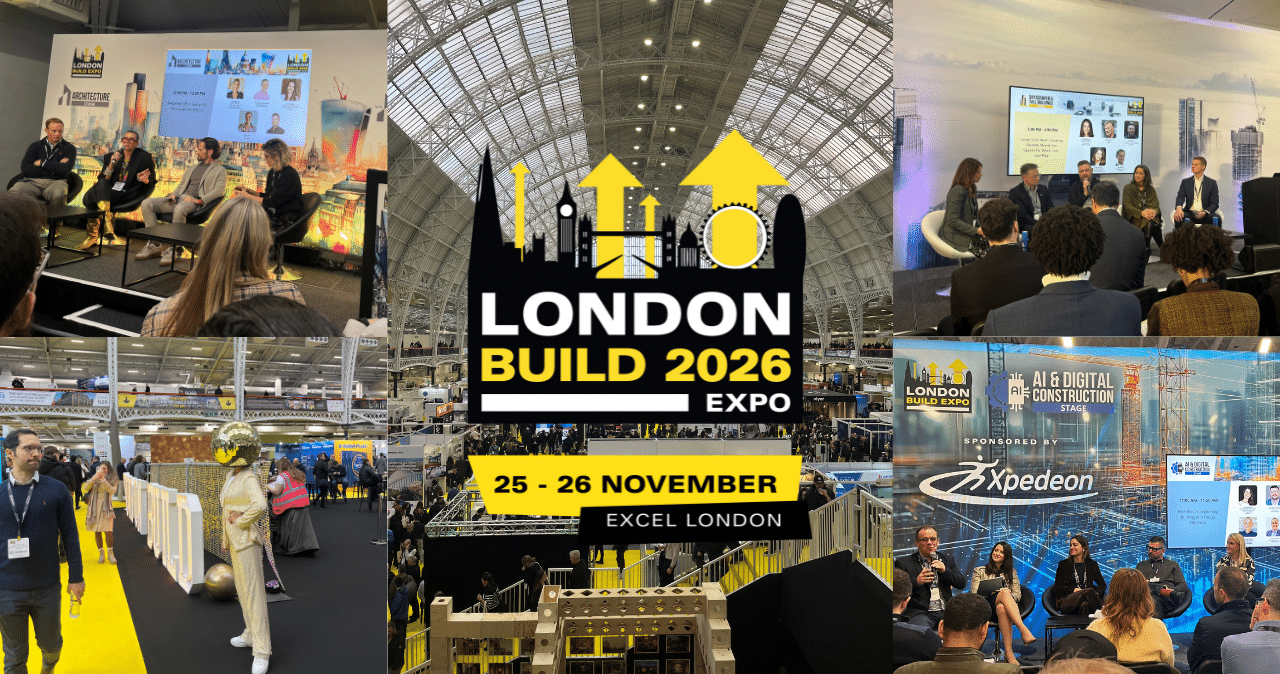
Recently, account executive Charlie Payne attended the UK’s leading and largest construction show, London Build, at Olympia London. With the recently renovated Victorian exhibition centre providing a fitting backdrop, the day was filled with insightful panel discussions spanning the built environment sector, covering construction and development, architecture, FM, and civil engineering.
An automated future for building management
On the ‘How AI is Transforming Building and Energy Efficiency’ panel, James Brown, managing director of NextGen Ri, was quick to point out that automation is as much about “freeing people up” as it is about replacing them. He illustrated this with examples of robotics in hazardous working environments; some machines can now perform detailed PPE checks before humans enter a site, while others can fully take on tasks that have traditionally put workers at risk.
NDY’s London sustainability lead, Zoe Neill, then offered her thoughts on how AI might help small FM teams feeling stretched. Many AI-driven platforms, she explained, can identify Building Management System errors more reliably than humans and are equipped with automated chatbots, which provide timely reminders when issues go unnoticed.
When the conversation turned to exciting trends and future predictions, Placemaking AI’s Yasemin Erdinc spoke on creativity – the idea that AI “adds colours to the palette” and helps us think outside the box. But the group’s collective consensus was that AI implementation should always start simple and be phased, and that those using it should always maintain an open mind.
Designing workplaces with meaning
On the Architecture stage, the ‘Designing Office Spaces for Tomorrow’s Workforce’ panel agreed that setting clear design goals at stage zero is essential. For Jane Clay, principal and design strategist at Gensler, this means being investigative and asking the client what they truly want from a workspace – what they want people to achieve there and which values they want it to represent.
This was balanced out by an emphasis on adaptability. Grant Kanik, deputy head of workplace consultancy at Foster + Partners, urged designers to always leave room for future layout amendments by separating a building’s shell from its interior features as much as possible.
The conversation turned to multigenerational workplaces, emphasising the need to consult every employee in the design process – not just the leadership team. Jane questioned how resilient a workplace design of the future can be if workers of the future aren’t engaged in shaping it.
Overall, a strong sense emerged that tomorrow’s workplaces must be defined by a deeper sense of meaning. As Grant mentioned, thoughtfully designed workspaces remain one of the most powerful ways for organisations to express what many early-career professionals now seek: clear values, a cohesive identity, and a culture to be proud of. Looking ahead, we can expect tangible office environments to become essential again, but perhaps for new reasons.
Mixed-use spaces
At the Skyscrapers & Tall Buildings Stage, planners, property managers, and marketing specialists discussed what truly makes a successful mixed-use space.
Across the board, continuous stakeholder engagement was deemed essential. Drawing on her experience at the Canary Wharf Group, Sian Astrop described how her team enhanced local sports offerings to reflect the naturally competitive culture of one of London’s most prosperous corporate districts. Canary Wharf’s footfall reached 105 per cent of its pre-pandemic levels this October, significantly outperforming the City of London’s 89 per cent. Initiatives like this seem to be paying off.
Versatility was then identified as a key factor in distinguishing a place within an increasingly crowded market. Director of marketing & communications at Olympia Events, Andy Price, shared how the venue’s two main halls can be flipped overnight to accommodate sporting events, concerts and conferences. Adrian Price then brought Building Design Partnership’s work at BOXPARK Croydon to the discussion, highlighting how its offerings are intentionally adjusted throughout the day to attract a variety of audiences.
Trends and takeaways
One key word heard throughout the day was ‘flexibility’. On every stage, industry leaders spoke about the need to stay adaptable and versatile in their strategies.
This speaks volumes about ongoing shifts occurring within the built environment sector, and the in-between phase it currently finds itself in. FMs are completely rethinking what efficiency and safety mean as they introduce AI and robotics; workplace designers are realising that their plans must anticipate rapidly changing employee preferences; and placemakers are recognising that the concept of a simple, ‘single-use’ space is disappearing.
Visit our blog page to find more event recaps like this one, and our LinkedIn to see posts from the ground.