
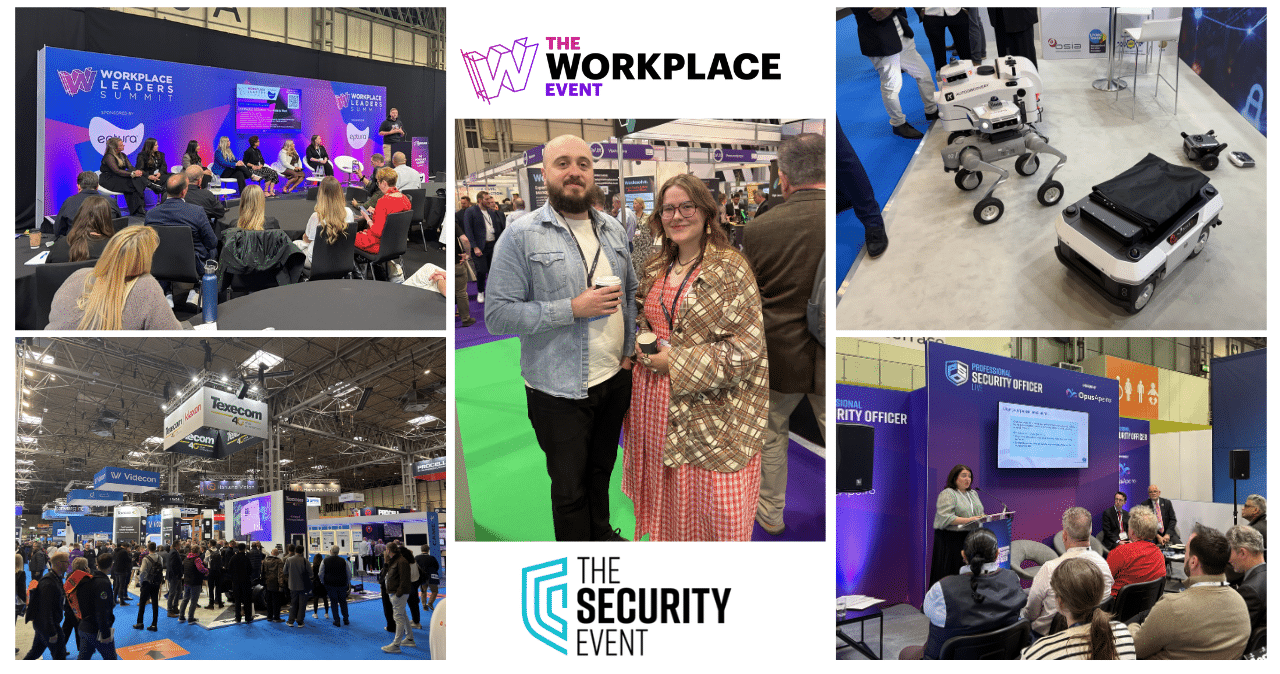
This year was my second at The Workplace Event (TWE), and if anything, it confirmed what last year suggested, that this is one of the most popular gatherings in the built environment calendar.
Across three days at the end of April, I was among thousands of visitors bustling between TWE and its co-events, including The Security Event (TSE), the Fire Safety Event, and the National Cyber Security Show.
It’s a given – AI and technology integration, along with the role of data in smarter buildings, were both key topics again. But running as an undercurrent throughout almost every session I attended was the question: how can we place people first while embracing emerging technology?
Belonging, culture, and the harder conversations
One of the panels I found most impactful was on belonging, hosted by Colin Kimber, culture and engagement director at Pareto. He’s also co-chair of the inclusive network LGBT+ in FM, whose committee I’m honoured to be part of.
Panellists spoke about how the pressure of team management can hinder your perspective, and the need to step back and realise that colleagues have their own needs and conflicts.
The point was also made that many organisations reach for technology and AI when the real work is internal. These tools can paper over cracks, but they can’t replace the environment in which people actually grow. Paula Brockwell of The Employee Experience Project emphasised that high performance comes from culture, but culture is built from more than cupcakes or team days. It also needs empathy and strategy.
Finishing each day, the “Unhinged” panel sessions were designed to ask the harder questions. Though moderated by IWFM chair Andrew Hulbert, all panellists across the three days were women. The second day’s panel, “The problem with men?”, covered the structural barriers women continue to face in FM and the workplace more broadly.
Marketer and LGBT+ in FM committee member Rowena Wilding observed that women move through the world in a constant state of risk assessment, thinking about what they are wearing, who they are with, and where they are, while men are often able to remain neutral to that same environment.
Philippa Perryman Coles, director of Share3, pushed back on the language of “imposter syndrome”, arguing that it pathologises what is actually a rational response to systems that weren’t designed with women in mind. It was a sharp session, packed with insight.
Social value at the forefront
The eponymously named Social Enterprise Village gave businesses delivering substantial social and environmental impact a chance to shine. One key session, “What is a social enterprise?” explored the power and impact of social enterprises. Paul Lotter, managing director of Corps Security, noted that organisations operating under this model have a significant advantage because, while they retain the same level of commercial acumen as conventional businesses, they are not driven by the same profit imperatives. As a result, they can prioritise environmental goals and creating social value.
Amy Kimberlin, social value co-ordinator at Overbury, and Yasmin Halai-Carter, CEO of social enterprise Ethstat, explored how to bring social value to life in projects. Amy detailed Overbury’s work with the enterprises Luminary Bakery and The Glass House who supported them during fit out projects. They both reflected that conversations on social value are maturing towards systemic considerations around local procurement to build lasting social and environmental economies.
Data and technological innovation
An NHS-focused Workplace Leaders Summit session offered a practical lens on utilisation data. Tasmyn Flynn of gbpartnerships, on behalf of the NHS Community Health Partnership, and Jantine van der Weerdt, CEO of Officebooking, drew on real-world case studies in the City of Coventry and South Liverpool Treatment Centre.
They detailed how smart sensor technology and occupancy analytics delivered evidence for confident estate decisions. On one site, sensor interventions had shown a 20-40% improvement in space utilisation, 25% fewer no-shows and 20% lower cleaning costs, showing the evidence base the sector increasingly needs when making the case for better building management.
At the Office Moving Alliance’s stand, the Q&A co-hosted by Business Moves Group shared the story behind a complex international move – including on best practice navigating changing regulatory landscapes across countries, moving delicate or specialist equipment on lengthy journeys, and ensuring continuity and care.
The SIA, Martyn’s Law and first aid
Over at The Security Event, the Professional Security Officer Live programme delivered a timely session on the changes the Security Industry Authority (SIA) is introducing. Michelle Russell, chief executive of the SIA, discussed the most significant changes to the SIA’s regulatory regime that are underway in its three-year strategy.
The SIA currently holds 45,001 active licence holders, and the expectation is that this number may fall as the authority focuses on ensuring only those meeting the highest standards retain their licence. The sector is still grappling with fragmentation. Of the 8,434 who renewed in 2025 and responded to the SIA’s survey, 63% paid for their own licence, and 25% were working flexibly across multiple employers.
Martyn’s Law, the Terrorism (Protection of Premises) Act, featured prominently across the event. The law requires premises and events to be prepared in the event of an attack. The Home Office’s final section 27 statutory guidance was published a couple of weeks before, and the SIA launched its consultation on section 12 guidance.
The SIA is currently negotiating with the Home Office on a funding model to allow premises time to prepare. Roughly 179,000 premises are expected to fall within scope, including 155,000 in the standard tier for premises between 200 and 799 individuals, and 24,000 in the enhanced tier for premises that can hold 800 or more individuals.
Michelle emphasised that security companies and individual officers are not themselves subject to the legal duties. The responsibility sits with the venue or event owner and cannot be delegated away, though tasks that support compliance can be. She directed people to the National Protective Security Authority and Protect UK for further guidance.
Michelle also reported that the SIA is consulting on whether a security-specific first aid qualification should sit within the licensing framework itself, rather than being obtained separately. First aid certification is a need for many officers on the frontline, and there’s a risk that it can currently lapse while in service, building the case for bringing it into the licensing framework.
Reflections on the three days
What I kept coming back to this year was that the best conversations, whether discussing space utilisation or security officers, weren’t just about technology or compliance.
If I could pick one theme, it would be “people”. Across the halls and the panels, conversations focused on how we treat people, how we use spaces, the qualifications that equip us best to support others, and the labour that keeps our buildings running.
We’re present at all major FM and built environment events throughout the year. Check out the sector news section of our blog for more event summaries like this one, and stay up to date with our LinkedIn.