
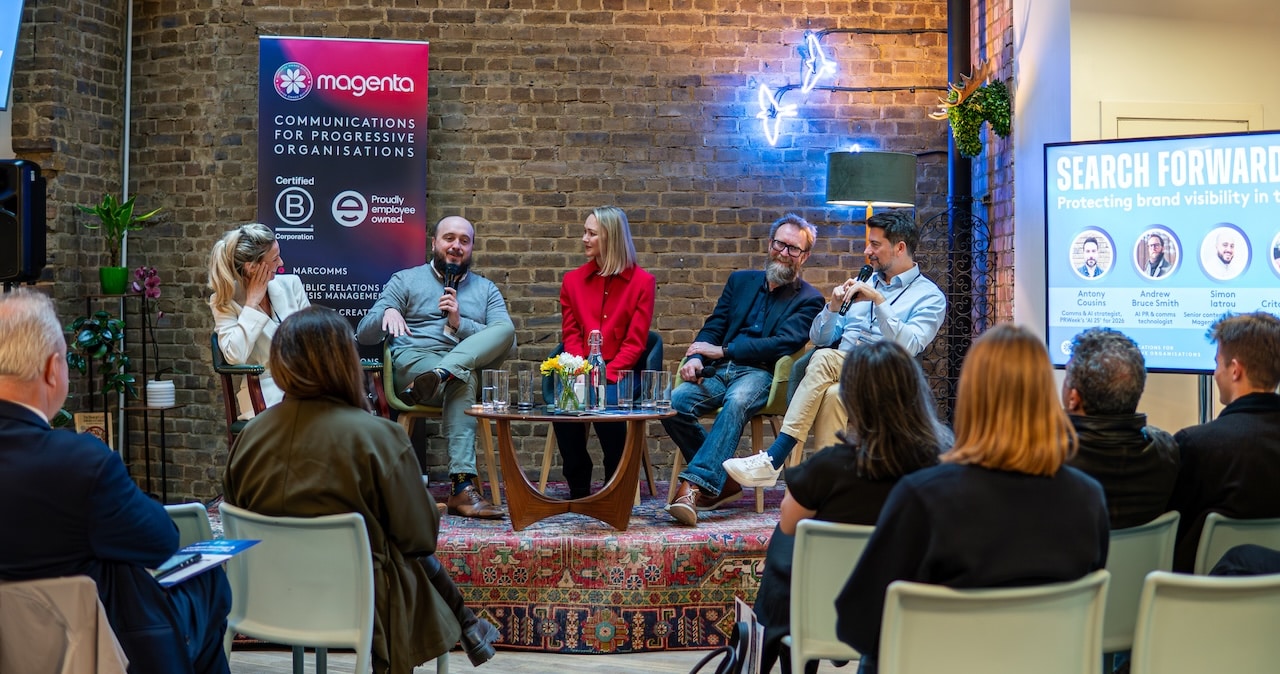
Magenta Associates recently brought together marketing and communications professionals in London for an evening of honest conversation about what AI is doing to brand visibility, and what to do about it.
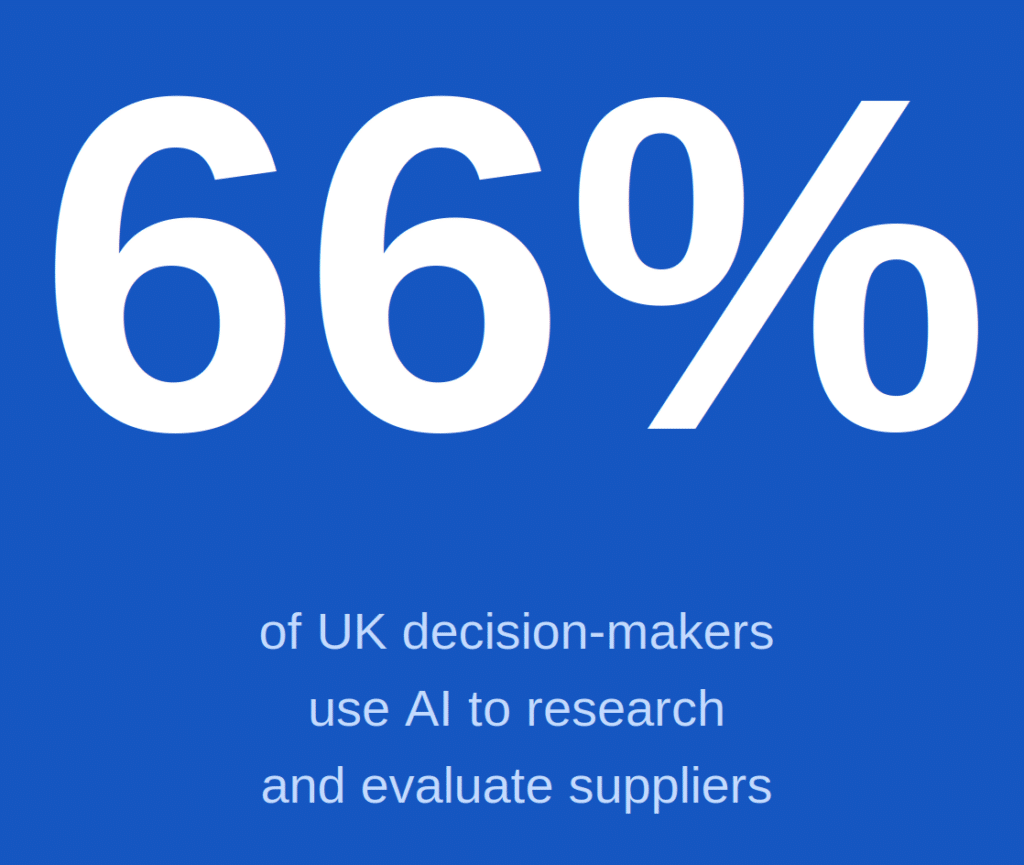
The event was the natural next step from our Search Forward research report, which found that two-thirds of UK decision-makers are already using AI tools such as ChatGPT, Copilot and Perplexity to find and evaluate suppliers. With 90% of those users trusting what they get back, and 85% having discovered a supplier they would not have found through traditional channels, the stakes for visibility have never been higher.
Our panel brought together four experts to discuss what that means in practice:
- Andrew Bruce Smith, Chair of the CIPR AI in PR panel and founder of Escherman
- Antony Cousins, comms and AI strategist named in PRWeek’s AI 25 for 2026
- Emma Critchley-Lloyd, chief marketing officer at Zodia Markets
- Simon Iatrou, senior content strategist at Magenta
Magenta’s MD, Jo Sutherland, chaired. Here is a recap of the key talking points from the evening.
Visibility in LLMs is still a little unclear
The panel agreed on one thing: anyone claiming to know exactly how to get your brand surfaced by an LLM should probably be treated with scepticism.
“Large language models are probabilistic, not deterministic systems,” said Andrew Bruce Smith. “There’s an awful lot of variability in all of this.”
Unlike traditional search, LLMs do not simply scan the top ten organic results. Andrew described a process called “query fan out”, where a platform like ChatGPT generates multiple internal prompts from a single user query, sometimes surfacing content that would sit on page 50 of a standard search. Meanwhile, the signals that determine whether a brand is cited or credible remain largely opaque and shift constantly.
Emma Critchley-Lloyd offered a useful real-world illustration. When searching for creative agencies via ChatGPT, she found two she had never encountered before. When she told the agencies how she had found them, neither had a conscious strategy in place. “It’s sometimes a little bit over-engineered and over-thought,” she said. “Just show up consistently and authentically in the places you know your audiences are.”
The move from keyword search to richer, conversational queries was a thread throughout the discussion. As Andrew put it, search engines conditioned us to use shorthand. Now people just ask what they want to know, often by voice. The content implications of that shift are significant.
Write for the person, not the machine
AI makes it easier to produce content, but this makes it harder to stand out. The panel spent time on what they called “AI slop” and why flooding the information environment with generic, machine-generated content is not a strategy.

“They’re designed to be mediocrity machines,” said Andrew of LLMs. “They’re designed to give you the average unless you tell them otherwise.”
Antony Cousins was direct about what good use of AI actually looks like. “If you give it enough context and guidance, it can produce pretty decent stuff. The problem is when you just go to AI and take the generic.”
He described a simple framework: if you enjoy a task and you are good at it, do it yourself. If you enjoy it but are not at your best, use AI to coach you. If you do not enjoy it but are competent, let AI draft and you quality-check. But if you neither enjoy nor excel at a task, do not simply hand it to AI and judge the output, because that is where slop comes from.
Emma was equally direct: “You can’t hack your way into trust.” She drew on her own experience watching AI-generated content in social feeds, noting the moment an audience clocks something is not real, the connection is broken.
The role of earned media came up repeatedly. Simon Iatrou noted that trade publishers are raising the bar on what they will run, looking for genuine insight rather than trend roundups. Andrew made the point that high-quality, third-party coverage is one of the clearest signals LLMs use to determine credibility. The paradox, as Simon pointed out, is that media traffic is falling even as media coverage matters more to AI visibility. That tension has no neat resolution yet.
Governance and shadow AI: the 80% problem
One of the more striking moments of the evening came when Jo Sutherland raised Magenta’s own research, conducted with the University of Sussex, which found that around 80% of people are using AI tools without authorisation or clear employer guidance.
“It’s rampant,” said Andrew. “People are using this stuff when they’ve either been told they shouldn’t, or they’re not explicitly told they can’t, but it’s kind of frowned upon. And they’re going: look, you’re putting this pressure on me to deliver all of this with that. Forget it. I’m just going to go and spend my own £20.”
Antony highlighted the legal and reputational dimension. While LLM providers may offer some indemnification against copyright risk, they cannot protect a brand against the reputational damage of accidentally replicating a competitor’s campaign or eroding public trust through poor-quality content. “The loss of trust and reputation is unrecoverable,” he said.
The panel also took aim at a common organisational response to AI: buying bulk software licences without involving the people who will actually use them. Andrew cited a stat suggesting that only 1 in 10 purchased Copilot licences is actively used: “They just bought the tech and then didn’t think about how it actually fits into how people work.”
According to Andrew, the one positive example that emerged was an organisation that sat down with its communications team first, asked what they actually do, and then made decisions about tooling from a position of understanding. “What a radical, revolutionary idea,” he added.
The generational divide
The conversation about junior roles was perhaps the most candid of the evening. Several panellists expressed concern about the growing trend of cutting entry-level positions on the assumption that AI can cover those tasks, and what that could mean in 5-10 years’ time.
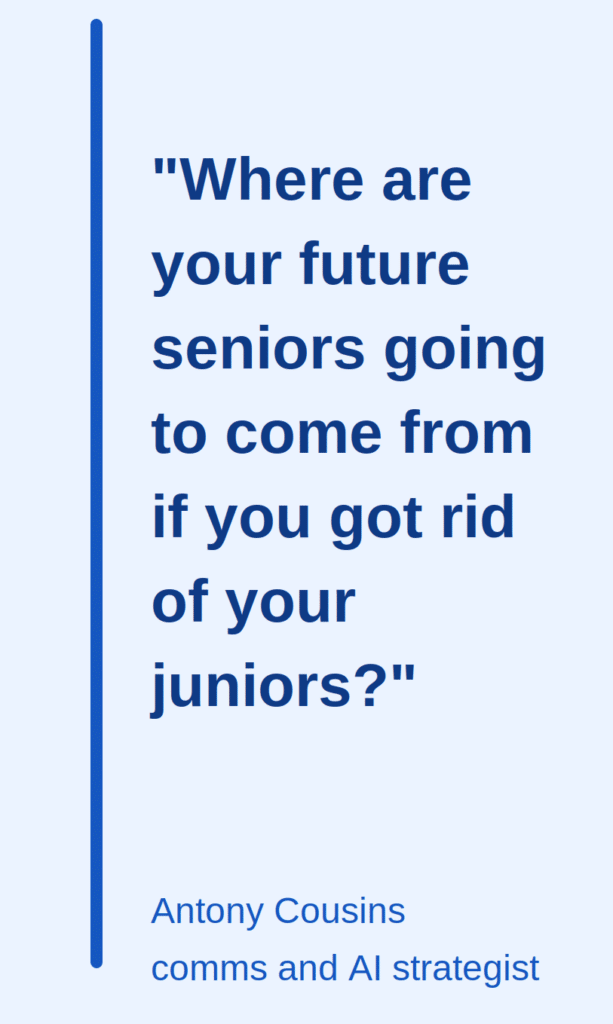
“Where are your future seniors going to come from if you got rid of your juniors?” said Antony. “It’s not the same kind of juniors you need, because the skill sets are different now. We need critical thinking and true novel creativity.”
Emma drew on her own career: “I learnt so much from my creative director who would take an idea that you thought was incredible and just rip it to pieces. That is how you get better.” Without that friction, she argued, younger professionals will struggle to develop the ability to handle constructive criticism or recognise what good looks like.
Andrew noted the irony in junior employees often as the ones driving genuine innovation with AI, finding novel applications that senior staff would never consider. “We’d cut our nose off to spite our face if we got rid of that,” he said.
Simon connected this to a pattern already familiar from discussions about hybrid and remote working: young professionals losing the chance to learn by osmosis, sitting alongside more experienced colleagues. “It’s a double whammy,” said Antony. “Since Covid we’ve all been working from home, they’ve lost those opportunities, and we’re now exacerbating that problem.”
The recommendation from the panel was not to abandon junior hiring, but to reorient those roles around critical thinking and AI management rather than task completion, and to invest in the training and mentoring that makes that possible.
The future of brand visibility
Want to dig deeper into any of these themes? We will be publishing longer pieces on each one over the coming weeks.
We’ll also be working on more research and keeping our finger on the pulse of how AI is impacting brand visibility.
In the meantime, you can read about our content strategy support and download the full Search Forward research – How AI is reshaping the B2B buyer journey.
If you’d like to discuss how Magenta can support your content strategy, send us an enquiry or email me greg@magentaassociates.co.